
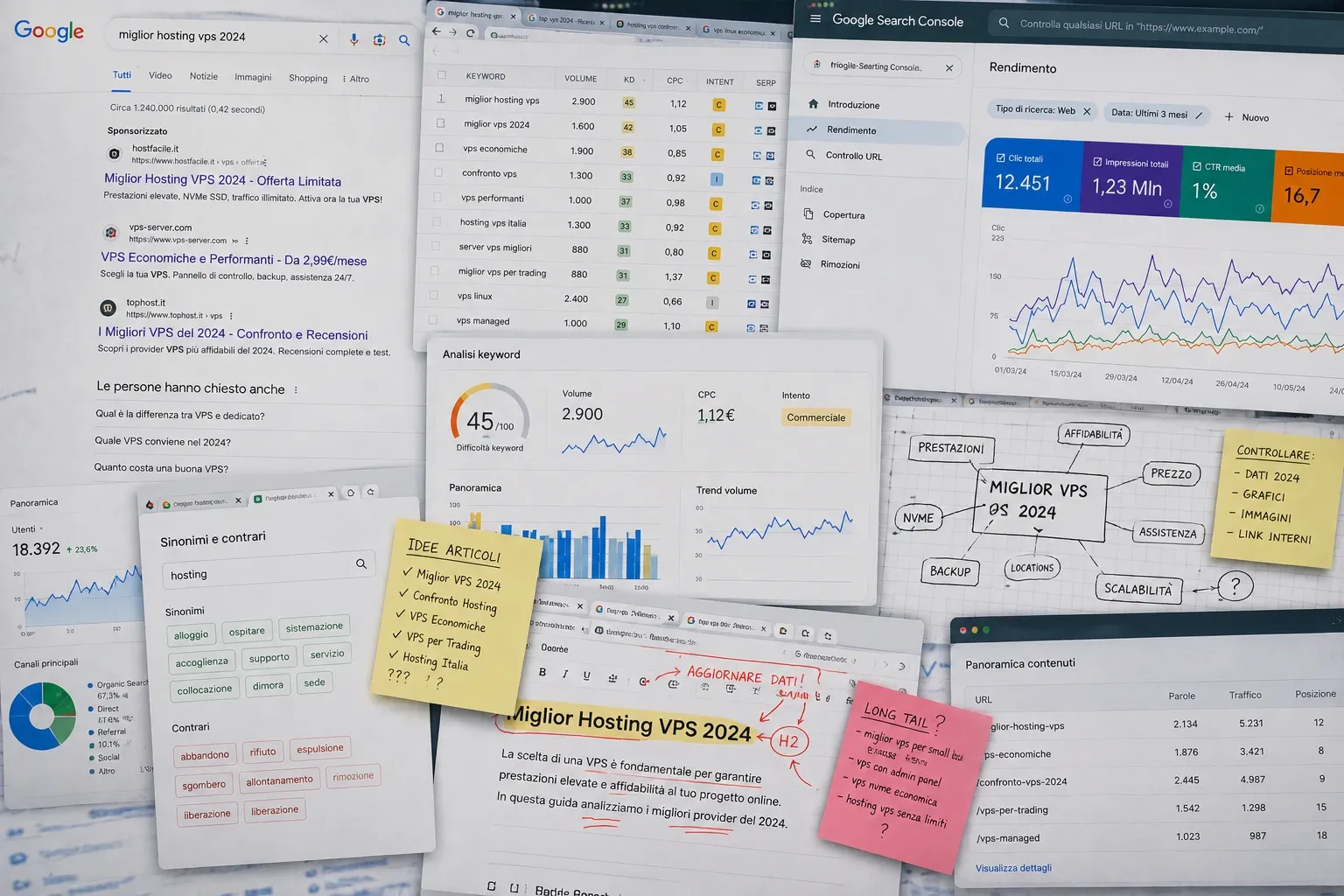
When the Algorithm Starts to Understand People
For more than twenty years, the Web has lived with a curious contradiction. On one side, there were millions of people looking for information, services, communities, and interesting content. On the other, there were search engines trying to understand which pages deserved to appear among the top results.
In between, an entire industry dedicated to search engine optimization developed. It is a completely legitimate activity when its goal is to make a website faster, more accessible, well structured, and easier to understand. Over time, however, in many cases the intended audience for content stopped being the person and started becoming the algorithm.
For years, we have watched a competition where the winner was not always the one building the best service or offering the most polished user experience. Often, projects were rewarded for producing huge numbers of optimized pages, targeting every possible search query, publishing extremely long articles full of repetition, multiplying nearly identical content, or exploiting the reputation of other companies and brands to attract traffic to websites that, in many cases, had very little to do with those brands. People browsing the Web would then end up on pages filled with intrusive ads, popups, artificially stretched text, and content built more to convince an algorithm than to truly help the reader.
Of course, this has never been the only reality. There have always been webmasters who chose a different path, investing time in content quality, site speed, usability, accessibility, and the creation of real communities. For a long time, however, all of this was not always enough to stand out in an ecosystem where the ability to interpret search engine logic often represented a huge competitive advantage.
Today, something seems to be starting to change. The arrival of artificial intelligence in search engines is changing the type of question these systems try to answer. For many years, the question was essentially this: "Does this page contain what I am looking for?" Today, the question seems to be evolving toward something different: "Is this page truly useful to the person who made this search?"
It may seem like a subtle difference, but in reality it completely changes the point of view. A system based on artificial intelligence does not simply check for the presence of certain keywords. It tries to understand the meaning of a text, the context in which it was written, the clarity of the explanations, the consistency of the information, and, at least in part, the authority of the source. This does not mean that artificial intelligence is infallible or that it can always distinguish excellent content from mediocre content, but the direction seems to be toward evaluating the real value of a page more and more, rather than only its technical optimization.
If this evolution continues, it could produce interesting effects. A small specialized blog might have a better chance of standing out thanks to the expertise of its author. A niche community could be valued because it produces authentic discussions. An independent project could manage to compete even without large investments dedicated exclusively to search engine rankings. This would not be the end of optimization: aspects such as performance, proper HTML structure, accessibility, and good content organization will continue to be essential. What may lose effectiveness is optimization for its own sake, built exclusively to manipulate rankings.
Users, meanwhile, are changing too. More and more people seem to be showing a certain fatigue with experiences built around algorithms. Interest is growing in newsletters, independent blogs, forums, niche communities, and spaces where users choose what to follow instead of relying entirely on the automatic suggestions of large platforms. This is not necessarily a return to the past, but perhaps the search for a more direct relationship with information and with the people who produce it.
In this scenario, artificial intelligence could play an almost paradoxical role. For years, it was believed that algorithms would mainly favor those with more financial resources, more content, and a greater ability to optimize every detail. Today, the opposite could also happen. If a system can truly recognize expertise, originality, and value, then smaller projects could also gain the visibility they deserve, simply because they have something useful to offer.
Of course, it is still too early to speak of a revolution. Search engines will continue to evolve, artificial intelligence will continue to improve, and no one can predict with certainty what the balance will be between traditional algorithms and new AI-based systems. But there is one perspective worth watching: for many years, success on the Web depended above all on the ability to understand algorithms. Perhaps we are entering a phase in which algorithms will have to understand people better and better.
If this direction is confirmed, the change could go far beyond search engines. It could be good news for the entire Open Internet, because a Web that rewards expertise, authenticity, user experience, and genuinely useful content is a Web where ideas become more valuable again than simple optimization tricks.