
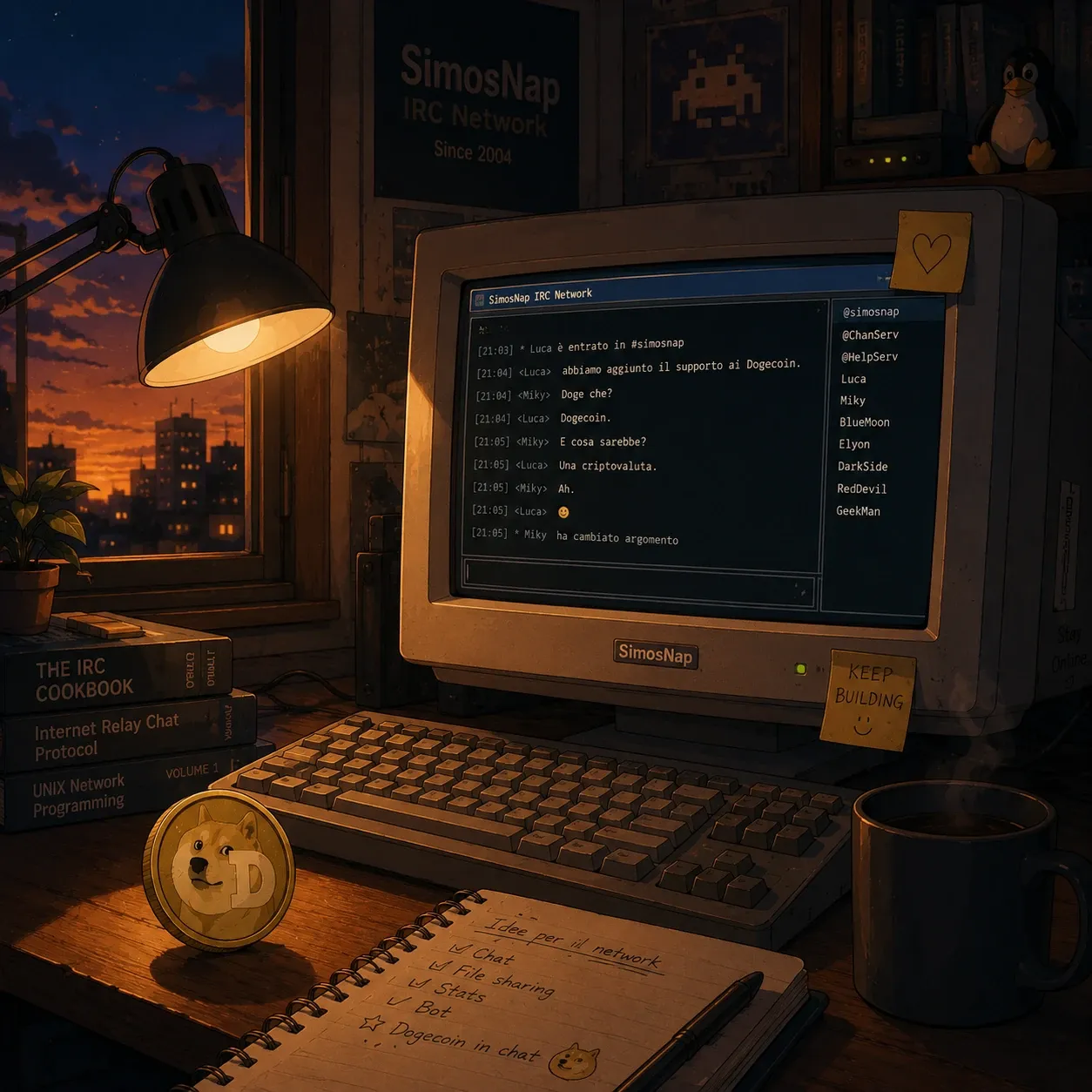
Some time ago, I added the ability to send Dogecoin directly from chats on SimosNap. It wasn’t a feature people were especially asking for, there weren’t dozens of users requesting it every day, and I wasn’t under the illusion that it would change the way people use IRC. And yet, while I was developing it, I had fun imagining how part of our community might react.
More or less, I pictured it like this.
"We’ve added Dogecoin support."
"Doge what?"
"Dogecoin."
"And what is that?"
"A cryptocurrency."
"Ah."
Then the conversation would probably have gone back to much more important topics, like football, the weather, work, or whatever else was being discussed at that moment.
The truth is, I didn’t add this feature because I expected it to become the center of attention. I did it because I’ve been following the world of cryptocurrencies for years, and because Dogecoin, among all of them, has always been the one that intrigued me the most. Not so much because of its economic value or the events that periodically put it back in the headlines, but because of its story.
Dogecoin was created in 2013 almost as a joke. It was meant to be a parody of the cryptocurrencies that were starting to become popular at the time. Many people thought it would disappear within a few months, replaced by the next new thing. Instead, it is still here. It has gone through waves of enthusiasm, periods of almost total indifference, and moments when it seemed destined to vanish, but somehow it has always continued to exist thanks to a community of people who never stopped believing in it.
Maybe that is exactly what fascinates me. I have always liked the stories of niche projects more than the stories of giants. I like watching those realities that keep moving forward even when everyone writes them off, those communities that withstand the years without necessarily becoming huge, while still maintaining their own identity.
After all, when I think about it, it is a story I know fairly well.
Since I founded SimosNap in 2004, I have heard people explain with absolute certainty many times that IRC had reached the end of the line. Over the years, forums were supposed to replace it, then MSN Messenger, then Facebook, then WhatsApp, then Telegram, then Discord, and tomorrow something else will probably arrive and be presented as the definitive successor to everything that came before.
In the meantime, more than twenty years have passed, and we are still here.
Of course, the world has changed. It would be absurd to claim otherwise. User habits are different, the Internet is different, and the way people communicate online has also changed profoundly. And yet there are still people who choose to join an IRC chat to meet someone, discuss a topic they care about, or simply spend an evening in good company.
Maybe that is why I feel close to the story of Dogecoin. Not because I intend to compare a cryptocurrency to an IRC network, but because both tell us something that almost feels out of fashion today: the ability to survive over time without necessarily chasing every trend of the moment.
When you run an independent project, you often end up building things that are not strictly necessary. Sometimes you do it because they are useful, sometimes because they are an interesting technical challenge, and other times simply because you like the idea. There is no marketing department handing you a list of priorities, and there is no meeting that has to approve every single decision. There is only the freedom to build something you find interesting and see what happens.
That is one of the things I have always loved most about developing SimosNap. Some features were immediately successful, others remained tools used by only a few people, and others mainly served as a way to learn something new. But all of them, in one way or another, are part of the project’s history.
That is why I do not particularly care whether the Dogecoin system is used by ten people, by a hundred, or by no one at all. I like the idea that it exists. I like the fact that an IRC network created in 2004 can still afford the luxury of experimenting, adding something unusual, and continuing to evolve without losing its identity.
And if someone really were to ask me, "Doge what?", I would probably smile and start telling the story all over again.